

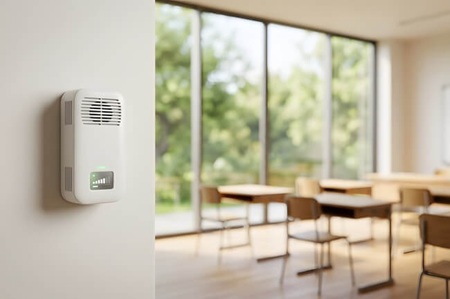
 School indoor air quality can change throughout the day as classrooms fill, shared spaces get busy and HVAC systems respond to changing schedules and outdoor conditions.
Regular indoor air quality monitoring helps facilities teams spot patterns, compare spaces and make better decisions about maintenance, filtration, controls and other HVAC needs.
A school can feel pretty quiet before the first bell. A few hours later, classrooms are full, the gym is busy, lunch is underway and nearly every part of the building is being used differently. Through all of that, the HVAC system is expected to keep temperature, ventilation and airflow comfortable from one space to the next.
A classroom that feels fine at 7:30 in the morning may feel stuffy or warm after 28 students have been sitting in it for two hours. Then the bell rings, the room empties, another group arrives, and the cycle starts again.
For school facilities teams, that can make school indoor air quality hard to judge at a glance. One room may seem fine while another is uncomfortable at the same time.
Regular indoor air quality monitoring gives facilities teams a way to see how indoor conditions change over time and identify where maintenance, repairs, controls adjustments or a closer HVAC evaluation may be needed before problems begin affecting students and staff.
Regular Monitoring Shows What a Single Reading Can Miss
A one-time reading can tell facilities teams what is happening in a room at that moment. Regular monitoring can show whether the same change happens again and again.
Maybe one classroom gets warmer and stuffier every morning once it fills, while conditions in the cafeteria consistently change during the busiest lunch period.
Those patterns give facilities teams more context than a single complaint or spot check. They can help show whether a concern is tied to occupancy, time of day, a specific zone or how the HVAC system is operating.
Over time, those patterns give facilities teams a clearer picture of what is happening and where to look next.
Regular Monitoring Helps Facilities Teams See Differences Between School Spaces
The way a space is used can create its own ventilation and indoor air quality demands.
Classrooms
Long stretches of back-to-back occupancy can put steady demands on ventilation and airflow.
Gyms
Large groups and physical activity can change conditions quickly, especially during PE classes, practices or events.
Cafeterias
Short periods of heavy occupancy, combined with cooking, exhaust and food service equipment, can create their own ventilation demands.
Science and art rooms
Activities, materials and equipment may require closer attention to airflow and ventilation than a standard classroom.
Libraries, offices and administrative areas
Lower or more consistent occupancy can make conditions here very different from busier parts of the building.
Looking at these areas separately can help facilities teams see whether a concern is isolated to one room, shared by similar spaces or connected to a larger HVAC zone.
School HVAC Systems Play a Major Role in Indoor Air Quality
School HVAC systems often have to support buildings that have evolved over time. Facilities teams may be managing:
- Original and newer building wings
- Multiple equipment types and brands
- Older and newer HVAC systems
- Classrooms, gyms, cafeterias and offices with their own schedules
With several systems, zones and schedules at work, a complaint in one part of the building does not always make the cause obvious.
When one part of the building starts behaving differently, facilities teams need to know which equipment serves that space and how it is operating. Monitoring data can help narrow the check to controls, ventilation, filtration or equipment performance.
The importance of air conditioning in schools goes beyond temperature control. HVAC systems also help support ventilation, filtration, humidity control and airflow throughout occupied spaces.
Understanding how these systems work together is an important part of planning HVAC services for schools.
Why Indoor Air Quality Patterns Matter
Changes in indoor air quality are not just a facilities concern. They can affect how students and staff feel throughout the school day and how comfortable the learning environment is.
Poor indoor air quality can contribute to headaches, coughing, irritated eyes, fatigue or trouble concentrating. Students with asthma, allergies or other respiratory sensitivities may be more affected by dust, moisture, mold, outdoor pollution and other airborne irritants.
School HVAC conditions can also affect the learning environment. A room that is too warm, poorly ventilated or consistently stuffy can become distracting and uncomfortable, especially as the day goes on.
Monitoring does not diagnose a health issue, but it can give facilities teams useful building information when concerns repeatedly show up in the same area or under similar conditions.
Outdoor Air Quality Can Affect Conditions Inside Colorado Schools
Colorado facilities teams know wildfire smoke can change outdoor air conditions fast. When particulate levels rise, the question becomes whether that smoke is making its way into classrooms and how well filtration and HVAC operation are responding.
Comparing indoor and outdoor conditions can help guide decisions about outdoor air intake, filtration and areas that may need closer attention. Instead of relying only on what conditions look or smell like outside, facilities teams have building data to help determine how indoor conditions are responding.
Indoor Air Quality Monitoring Helps Facilities Teams Make Better Decisions
The real value of regular monitoring is what facilities teams can do with the information. Patterns over time can help them:
- Prioritize where to investigate first
- Compare similar spaces for recurring differences
- Identify possible maintenance needs
- Evaluate HVAC schedules and controls
- Guide adjustments to filtration or outdoor air settings
- Confirm whether a repair or adjustment helped
Monitoring may not identify the cause on its own, but it can help move the team from a general complaint to a more focused investigation and a more targeted response.
When the pattern points back to ventilation, airflow, filtration or equipment operation, the next step may be HVAC maintenance, a controls adjustment, equipment repair or targeted indoor air quality testing.
Frequently Asked Questions About School Indoor Air Quality Monitoring
How often should schools monitor indoor air quality?
The right frequency depends on the building, the concern and how the space is used. Some schools may benefit from continuous monitoring in high-use areas, while others may use periodic monitoring to look for trends or investigate specific concerns.
What should schools do if one classroom keeps showing unusual readings?
Start by comparing that room with nearby spaces and looking at when the changes occur. Occupancy, HVAC schedules, airflow, filtration and the equipment serving that area can all provide clues about where to investigate next.
Is indoor air quality monitoring the same as indoor air quality testing?
Not exactly. Monitoring looks at how conditions change over time, while testing may involve a more targeted investigation of a specific concern. Monitoring can help identify patterns that point to where more detailed testing may be useful.
Can indoor air quality monitoring help with preventive maintenance?
Yes. Monitoring can provide additional information about how spaces and HVAC zones are performing over time. Repeated changes may help facilities teams identify where equipment, controls, filtration or airflow need closer attention before the issue becomes a larger or more persistent problem.
Does wildfire smoke affect indoor air quality in schools?
It can. Outdoor smoke and fine particles may enter school buildings, especially when outdoor air quality deteriorates quickly. Monitoring indoor conditions alongside outdoor air quality can help facilities teams understand whether smoke is affecting classrooms and whether HVAC or filtration adjustments may be needed.
Get a Better Read on Your School’s Indoor Air Quality
If concerns are showing up in classrooms or shared spaces, Chiller Systems Service can help evaluate the HVAC conditions that may be contributing.
Explore our indoor air quality services or HVAC services for schools to see how we support Colorado education facilities.