

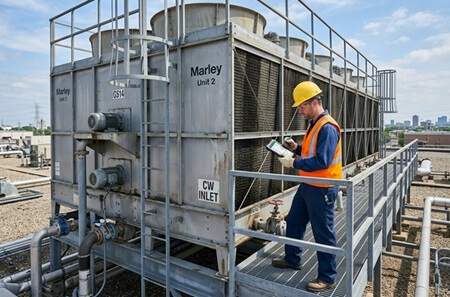
 Cooling towers can operate for months without obvious problems, but seasonal startups, equipment changes, unexpected test results, or compliance reviews often reveal gaps that have quietly developed over time. This guide explains what effective Legionella prevention and ASHRAE 188 compliance look like in practice, when a cooling tower deserves a closer mechanical review, and how facility teams can better coordinate with water treatment, safety, and mechanical partners. It also includes a practical Cooling Tower Checklist for Seasonal Startups and Compliance Reviews to help you evaluate your system, verify documentation, and prepare for your next inspection or audit.
Most facility teams do not think about Legionella prevention until something changes. A cooling tower comes back online after sitting idle, water treatment falls behind schedule, an unexpected test result comes in, or a compliance review sends everyone looking for maintenance records.
Those moments can uncover problems that were easy to miss during normal operation. A repair may have changed how the system runs, circulation may not be as consistent as it should be, or the records may no longer match what is happening in the equipment.
At Chiller Systems Service, we help Colorado facilities evaluate the mechanical condition of cooling towers before those issues become larger operational or compliance concerns.
Legionella prevention requires coordination between facility teams, water-treatment providers, safety professionals, and mechanical service partners. Each plays a different role in keeping the water-management program on track.
What ASHRAE 188 Compliance Looks Like in Practice
ASHRAE 188 compliance provides a framework for managing Legionella risk in building water systems. For cooling towers, that includes identifying potential hazards, establishing control measures, monitoring operating conditions, and documenting what happens when results fall outside the expected range.
The standard establishes minimum requirements for a Legionella water-management program, but each facility must apply them to its own systems, risks, and operating conditions. In practice, that means the written plan has to match the way the cooling tower is actually operating today, not the way it operated when the plan was first created.
A strong Legionella risk assessment should look at how the cooling tower is designed and operated, where water may move slowly or become stagnant, and whether scale, corrosion, sediment, or biological growth are present.
It should also consider the water-treatment process, seasonal startup and shutdown procedures, recent maintenance or system changes, and the needs of the people who use the building.
Those findings should shape the water-management plan and help the team decide what needs to be monitored, when testing is appropriate, and what should happen when conditions change. For facilities focused on Legionella compliance for cooling towers, the written plan should reflect how the system is actually operating today.
In the field, the strongest programs are usually the ones where each part of the process connects clearly to the next.
| Water-management element | What the facility should be able to show |
| Responsible team | Names, roles, and decision-making authority |
| Legionella risk assessment | Review of systems, hazards, and operating conditions |
| Control measures | Steps used to reduce identified risks |
| Monitoring | Completed records showing controls were checked as planned |
| Corrective action | A documented response when results fall outside established limits |
| Documentation | Records of findings, decisions, completed work, and follow-up results |
| Program review | Evidence that the plan was reviewed after changes or incidents |
Best practice: Treat the water-management plan as an operating process, not a document reviewed only once a year.
Cooling Tower Legionella Testing and Monitoring
Once the program is in place, the next step is making sure cooling tower conditions are monitored consistently.
Cooling tower Legionella testing is one part of a broader prevention strategy. Routine water testing may track treatment and operating conditions, while Legionella-specific testing looks for the organism itself. The water-management plan should explain when each type of testing is used, who reviews the results, and what happens next.
During cooling tower inspections, Chiller technicians also look for mechanical conditions that may affect the larger program. That includes scale, corrosion, debris, biological growth, and the condition of the basin, fill, drift eliminators, makeup water, blowdown, circulation, and low-flow areas.
We have seen facilities with strong water treatment for Legionella prevention struggle when mechanical issues interfere with consistent circulation or tower operation. Testing results are more useful when they are reviewed alongside current equipment conditions and actual system performance.
When Cooling Tower Conditions Need Another Look
Routine monitoring provides the baseline, but certain operating changes call for a closer mechanical review. We often recommend another look after:
- Extended shutdowns or seasonal restarts
- Construction, equipment, or building-use changes
- Water-treatment interruptions
- Unexpected or repeated out-of-range results
Depending on what changed, the next step may include a mechanical inspection, treatment verification, corrective maintenance, updated monitoring, or additional testing under the facility’s response plan. In some cases, recurring mechanical problems may indicate it’s time to evaluate whether continued repairs are the best long-term investment. Learn how to determine whether a cooling tower should be repaired or replaced.
Make Corrective Actions Easy to Trace
When an issue requires action, the documentation should show more than the work order or final repair. A note that says “tower cleaned” leaves important questions unanswered.
A stronger record identifies the out-of-range condition, the work completed, the responsible person, the completion date, and the follow-up result confirming that the system returned to control.
It should also show who reviewed the finding, what action was approved, and whether additional monitoring or testing was completed. If the event revealed a new or recurring risk, the water-management plan may also need to be revised.
Audit-ready means traceable. A reviewer should be able to follow the record from the original result through corrective action and final verification.
Check the Mechanical Side of the Program
Seasonal startup is one of the times mechanical issues are most likely to become visible. Pumps, controls, strainers, valves, and tower components that have been sitting idle can all affect how the system performs once it returns to service.
The same is true after a treatment change, recurring repair, or operating adjustment. A mechanical review can help determine whether equipment conditions are affecting circulation, tower performance, or the larger water-management process.
Chiller Systems Service helps facility teams evaluate cooling tower operation, controls, mechanical condition, maintenance needs, and service documentation. Any concerns can then be addressed with the facility’s water-treatment, safety, and compliance partners.
Cooling Tower Checklist for Seasonal Startups and Compliance Reviews
Before the next startup, inspection, or unexpected result, use these questions to check whether the facility, water-treatment, and mechanical sides of the program are working together.
Program and responsibility
- Is the water-management plan current, and can the team show when it was last reviewed and approved?
- Has the Legionella risk assessment been reviewed recently?
- Are responsible team members, vendors, and approval roles clearly identified?
- Is there a current system description or process flow diagram?
Monitoring and testing
- Are routine water-treatment parameters monitored at the planned frequency?
- Is Legionella-specific testing completed when required by the water-management plan or applicable rules?
- Are sampling locations, dates, methods, and results documented?
- Are missed checks and unusual results investigated?
Corrective action and documentation
- Are response steps defined before a problem occurs?
- Does each corrective action include an owner, completion date, and follow-up verification?
- Are repairs, cleaning, and treatment changes recorded?
- Can the team trace an out-of-range result from detection through response and verification?
- Is the plan updated after major operational changes?
System condition and maintenance
- Are cleaning, inspection, repair, startup, and shutdown records current?
- Are recurring circulation, control, or equipment issues documented and followed through to resolution?
- Are treatment and mechanical changes reflected in the water-management plan?
These are the kinds of questions that help our technicians understand whether the equipment condition and the water-management records are telling the same story.
Cooling Tower Legionella FAQs
What is ASHRAE 188, and why does it matter for cooling towers?
ASHRAE 188 provides the framework for managing Legionella risk in building water systems. For cooling towers, that means having a current water management plan, monitoring system conditions, documenting corrective actions, and making sure the plan reflects how the equipment is actually operating. Chiller Systems Service helps facility teams evaluate the mechanical side of the cooling tower so it supports the larger water management program.
How often should cooling towers be tested for Legionella?
There isn’t a one-size-fits-all schedule. Testing should be based on your facility’s water management plan, Legionella risk assessment, operating conditions, and applicable regulations. If your system has experienced a shutdown, major repair, or other significant change, additional testing may also be appropriate. Chiller Systems Service works alongside your water treatment provider by identifying mechanical issues that could affect overall system performance.
What documentation supports ASHRAE 188 compliance?
Good documentation goes beyond test results. Facilities should maintain records of inspections, monitoring, maintenance, repairs, corrective actions, follow-up verification, and any changes made to the cooling tower or water management program. During inspections and service visits, Chiller Systems Service helps facility teams document mechanical findings so equipment records support the broader compliance effort.
How does water treatment help prevent Legionella?
Water treatment is an important part of Legionella prevention because it helps control scale, corrosion, sediment, and biological growth. But it works best when paired with a well-maintained cooling tower. Chiller Systems Service helps facilities identify mechanical issues, circulation problems, and equipment conditions that can impact the effectiveness of a water treatment program.
What helps reduce Legionella risk in healthcare facilities?
Healthcare facilities often serve people who are more vulnerable to Legionella exposure, making a well-managed cooling tower especially important. Regular inspections, a current water management plan, consistent monitoring, and documented corrective actions all help reduce risk. Chiller Systems Service works with facility teams to keep the mechanical side of the system operating reliably as part of that larger effort.
What testing cadence is required for cooling tower water treatment?
Your water treatment provider should establish a testing schedule based on your system, operating conditions, and treatment program. Facilities should also increase monitoring after seasonal startups, treatment interruptions, unexpected test results, or major operational changes. Chiller Systems Service can help determine when a mechanical inspection should be part of that response.
Keep Legionella Prevention Active
Legionella prevention is a team effort. Facility managers, water-treatment providers, safety professionals, and mechanical service partners each have a distinct role in keeping the program effective.
Chiller Systems Service partners with Colorado facilities to keep cooling towers operating safely and reliably. Through inspections, maintenance, repairs, controls support, and seasonal startup services, we help ensure the mechanical side of your system supports your overall water management program.
Whether you’re preparing for a seasonal startup, compliance review, or peak cooling season, explore the areas we serve or contact Chiller Systems Service to schedule a cooling tower inspection. We’ll help identify mechanical concerns so your equipment is ready to support your water management program.