

A 10-Step Decision Framework
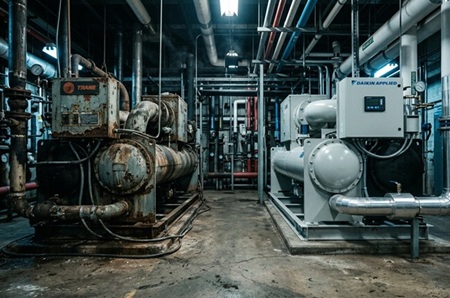 When a chiller or cooling tower starts having issues, it’s not always clear whether you should repair it, upgrade it, or replace it altogether. Making the wrong call can lead to higher costs, unexpected downtime, and ongoing performance problems.
This guide walks through a practical 10-step framework to help you evaluate your system, understand what’s really going on, and decide the best path forward. By the end, you’ll have a clearer way to balance cost, reliability, and long-term value so you can have confidence in your system’s maintenance decisions.
When an aging chiller or cooling tower starts causing problems, the real question is not just whether it can be repaired.
It’s whether repair is still the right decision for your facility.
For facility directors, plant engineers, and operations teams, this isn’t just a maintenance issue. It affects uptime, energy use, water use, budget planning, and long-term reliability. In some cases, repair is the smart move. In others, a retrofit makes more sense. And sometimes replacement is the better long-term call.
The key is to make the decision based on the full picture, not just the latest breakdown.
Why this decision matters
Aging equipment can stay online long after it stops being cost-effective.
Older chillers and cooling towers often bring:
- more frequent repairs
- lower efficiency
- higher energy and water costs
- parts availability issues
- refrigerant or controls concerns
- increased downtime risk
For commercial and industrial facilities, those issues add up quickly. A cooling failure can disrupt operations, create occupant complaints, force emergency spending, or put critical processes at risk.
That’s why the right decision isn’t always the cheapest one today. It’s the one that makes the most sense for reliability, service life, and long-term value.
Here’s a practical 10-step framework to help evaluate whether to repair, retrofit, or replace aging chillers and cooling towers.
A 10-Step Framework for Repair Vs. Replace
1. Start with age and expected service life
Age is not the only factor, but it matters.
As chillers and cooling towers get older, wear shows up across compressors, motors, controls, heat exchangers, tower structure, fill, and fan assemblies. Even if the system is still running, performance and reliability may already be slipping.
If the equipment is near the end of its expected life, it’s worth asking whether continued repair still makes sense.
2. Look at the condition of the whole system
Don’t make the decision based only on the part that failed.
A motor, fan, tube bundle, or control issue may be repairable. But if the rest of the system shows corrosion, scaling, structural wear, poor water treatment, or repeated failures, that changes the conversation.
A full assessment should look at:
- compressors and motors
- condenser and evaporator condition
- controls and sensors
- tower basin, casing, and structure
- fan drives, bearings, and gearboxes
- fill, nozzles, and drift components
- water treatment and fouling
3. Decide whether the problem is isolated or part of a pattern
This is one of the most useful steps.
Ask whether this is a one-time issue in an otherwise solid system, or part of a larger decline. An isolated repair may be worth making. A pattern of recurring mechanical, controls, or performance issues usually points to retrofit planning or replacement.
4. Review repair history and reliability
One repair does not mean it’s time to replace the system.
But repeated repairs, emergency calls, and shorter intervals between failures are signs the equipment is becoming less dependable. And for many facilities, reliability matters as much as repair cost.
If the system cannot be counted on when loads are high or conditions are critical, that has to weigh into the decision.
5. Compare repair cost to lifecycle cost
Do not compare repair cost only to the price of replacement.
Look at the full lifecycle cost, including:
- the immediate repair
- the chance of more repairs soon
- remaining useful life
- energy and water use
- maintenance burden
- downtime risk
- timing of future capital needs
A repair that only buys a little more time may not be the most cost-effective option once the rest of the picture is considered.
6. Consider retrofit as a viable option
Repair and replacement aren’t the only routes to take. Sometimes, a retrofit can boost reliability and performance, sidestepping the expense of a complete overhaul. This could involve:
- controls upgrades
- variable frequency drives
- fan or motor upgrades
- tower component replacement
- heat transfer improvements, BAS integration
- refrigerant planning
If the existing equipment still holds value, a retrofit might be the most sensible approach.
7. Factor in refrigerant, controls, and parts availability
Older chillers often bring support issues beyond normal wear.
If the system depends on outdated controls, hard-to-find parts, or aging refrigerants such as R-22, repair decisions become more complicated. Long-term support, compliance, and operating cost all need to be considered.
This is also where future planning matters. In some cases, retrofit can reduce risk. In others, replacement is the cleaner long-term answer.
8. Evaluate energy and water performance
A system can still run and still cost too much to keep up.
Older chillers and cooling towers often lose efficiency over time. Build-up on heat transfer surfaces, worn components, outdated sequencing, and poor tower performance can all drive up operating costs.
If the system is using too much energy or water to deliver the performance you need, repair may not solve the real problem.
9. Measure downtime risk and redundancy
The more critical the system, the less room there is for uncertainty.
If there is limited redundancy, or if the equipment supports critical operations, tenant comfort, or production processes, downtime risk should carry more weight. A repair may look reasonable on paper, but another failure can quickly change the math.
This is where operational risk has to be part of the decision, not an afterthought.
10. When repair stops making sense
By this point, you can usually see where things are headed.
A single repair on a solid system is one thing. A system that keeps breaking down, costs more to keep running, and is harder to trust is something else.
That’s when the question shifts from “Can we fix it?” to “Does it still make sense to keep investing in it?”
When chiller repair makes sense
Sometimes the right answer is to make the repair and keep going. Repair usually makes sense when:
- the issue is limited and the rest of the system is still in good shape
- the equipment has been reliable and parts are still available
- the repair is likely to give you meaningful service life
When a chiller retrofit is worth considering
Sometimes the system still has value, but parts of it are starting to fall behind. Retrofit is often worth considering when:
- the core equipment is still sound
- controls, efficiency, or key components need improvement
- you want to reduce risk without taking on full replacement cost
When replacement becomes the smarter move
There comes a point where another repair stops being the best use of time and money. Replacement deserves a closer look when:
- breakdowns are becoming more frequent
- costs keep rising and reliability is slipping
- parts, controls, or refrigerant issues are making the system harder to support
Frequently Asked Questions About Chiller Repair Vs. Replacement
How do I know if my chiller needs to be repaired or replaced?
The answer usually isn’t just about the part that failed. It’s about how the whole system is performing. If this is a one-time issue and the chiller has been reliable, a repair is often the right move. But if problems keep coming back, costs are creeping up, or performance isn’t where it should be, it may be time to think bigger. At Chiller Systems Service, we help you look at the full picture so you can make a decision that actually holds up, not just one that gets you through the next breakdown. Got questions? Contact us.
What is the lifespan of a commercial chiller?
Most commercial chillers last around 20 to 25 years. That said, how the system has been maintained makes a big difference. We’ve seen well-maintained equipment run longer, and we’ve seen systems wear out sooner due to heavy use or poor water treatment. If your chiller is getting up there in age, it’s a good time to start planning ahead, even if it’s still running.
Is it worth repairing an old chiller?
It can be. If the system is still in decent shape and the issue is limited, a repair can buy you more time. But if you’re putting money into it again and again without getting consistent performance, that’s usually a sign the value isn’t there anymore. We work with teams to figure out whether a repair will actually extend the life of the system or just delay a bigger decision.
When does chiller replacement make more sense than repair?
Replacement starts to make more sense when the system becomes hard to rely on. If you’re dealing with frequent breakdowns, rising costs, or parts that are harder to find, it may be time to move on. The same goes if the system struggles to keep up during peak demand. Our goal at Chiller Systems Service is to help you make that call with confidence, so you’re not stuck reacting to the next failure. Read more about how we work.
Make the decision that gives you the best outcome
This isn’t about defaulting to replacement. It’s also not about holding onto aging equipment longer than makes sense.
It’s about looking at the system clearly and making the decision that gives you the best outcome.
Sometimes, the best course of action is to fix the existing equipment, extending its lifespan. Other times, upgrading specific parts is the way to go. And occasionally, it’s clear that a complete system replacement is the best move, paving the way for something more dependable.
At Chiller Systems Service, we help facility teams make those calls with a focus on uptime, performance, and long-term value. The goal is simple: help you choose the option that makes the most sense for your facility and your budget.